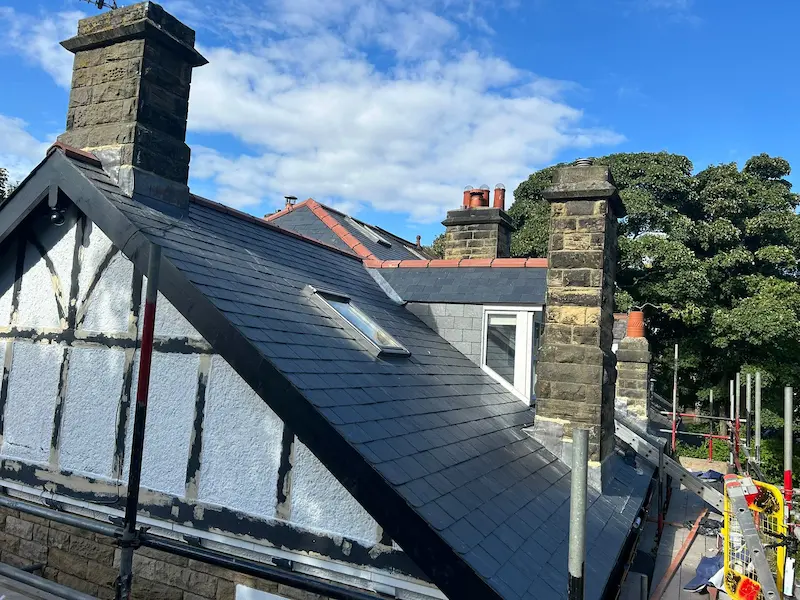
Newcastle receives approximately 800mm of rainfall annually — above the UK average of 680mm — along with regular freeze-thaw cycles from October to March and salt-laden Atlantic wind. These conditions are harder on roofing materials than anywhere in the South of England, and your choice of tile affects how your roof performs over the next 30–100+ years.
At VM Roofing, we install both materials regularly across Newcastle, Gateshead, Sunderland, and Durham. This comparison is based on 26 years of observing how both perform on North East properties.
At a Glance: Comparison Table
| Factor | Welsh Slate | Concrete Interlocking Tiles |
|---|---|---|
| Expected Lifespan | 80–150 years | 30–50 years |
| Supply & Fit Cost (per m²) | £60–£100 | £40–£65 |
| Weight (per m²) | 25–35 kg | 40–55 kg |
| Water Absorption | <0.3% | 5–8% |
| Freeze-Thaw Resistance | Excellent | Good (degrades over time) |
| Maintenance Frequency | Every 20–30 years | Every 10–15 years (moss treatment) |
| Planning Restrictions | Required for listed buildings | Not usually required |
| Appearance | Premium, natural, aged patina | Clean, uniform, modern options |
| Reclaimed Availability | Good (for heritage matching) | Poor |
| Whole-Life Cost (80 years) | Lower overall | Higher (2–3 replacements) |
Welsh Slate: The North East's Heritage Choice
The majority of Newcastle's Victorian and Edwardian terraces — in areas like Heaton, Jesmond, Fenham, and Arthur's Hill — were originally roofed with Welsh slate from the Penrhyn or Ffestiniog quarries. Many of these roofs are still performing 120 years later, having outlasted multiple sets of concrete tiles on neighbouring properties.
Why Slate Performs in Newcastle's Climate
Slate's key advantage in the North East is its exceptionally low water absorption rate — typically below 0.3% by mass, compared to 5–8% for concrete tiles. This is critical in a freeze-thaw climate: water that has been absorbed by a porous tile expands by approximately 9% when it freezes, causing micro-fractures in the tile body. Over 10–15 winters, this produces spalling (surface flaking) and eventually structural failure.
Welsh slate also benefits from its natural laminar structure — the same characteristic that allows it to be split thinly without artificial binding agents. This gives it a flexibility that resists wind uplift better than rigid concrete alternatives.
The Cost Premium: Is It Worth Paying?
Welsh slate typically costs £60–£100 per m² supplied and fitted in the North East, compared to £40–£65 for concrete interlocking tiles. On a typical Newcastle semi-detached (approximately 65 m² of roof), that represents a price difference of £1,300–£2,275.
However, over an 80-year horizon, concrete tiles require replacement every 30–50 years — meaning 2 to 3 complete replacements versus one slate installation. Including scaffold, labour, and materials at today's prices, the whole-life cost of a concrete tile roof significantly exceeds that of slate.
Concrete Interlocking Tiles: The Practical Modern Choice
Concrete interlocking tiles — manufactured by brands such as Marley, Redland, and Sandtoft — are the most commonly installed roof tile on North East properties built or re-roofed since the 1970s. They offer a genuine balance of cost, performance, and reliability.
Where Concrete Tiles Make More Sense
Newcastle-Specific Considerations for Concrete Tiles
In the North East's acid-rain environment, concrete tile surfaces are more susceptible to atmospheric degradation than in southern England. The surface treatment begins to erode after 15–25 years, increasing water absorption and encouraging lichen and moss colonisation.
VM Roofing recommends a professional moss treatment and re-sealing programme every 10–15 years for concrete tile roofs in Newcastle, Gateshead, and Sunderland.
Our Recommendation by Property Type
Frequently Asked Questions
How long does a Welsh slate roof last?
A properly installed Welsh slate roof typically lasts 80–150 years. The slate itself can last 200+ years — it is the nails and underlay that degrade first. Many Victorian and Edwardian terraces in Newcastle still have their original Welsh slate roofs, now over 120 years old.
How long do concrete roof tiles last?
Concrete interlocking roof tiles typically carry a 30–50 year product guarantee from manufacturers. In practice, the tiles often outlast the guarantee — but surface erosion in the North East's acid rain environment means colour fading and porosity increases over time, requiring moss treatment every 10–15 years.
Is Welsh slate more expensive than concrete tiles?
Yes. Welsh slate typically costs £60–£100 per m² supplied and fitted in the North East, compared to £40–£65 per m² for concrete interlocking tiles. However, the significantly longer lifespan of slate (80–150 years vs 30–50 for concrete) means the whole-life cost per year is broadly comparable.
Are concrete tiles or slate better for Newcastle's weather?
Both perform well in Newcastle's weather, but Welsh slate has the edge in freeze-thaw resistance due to its very low water absorption rate (less than 0.3%, vs 5–8% for concrete tiles). In extreme freeze-thaw cycles — which Newcastle experiences several times per winter — slate retains structural integrity better than concrete.
Can I replace concrete tiles with slate on my existing roof?
Yes, but you must check the roof structure can carry the additional weight first. Welsh slate weighs approximately 25–35 kg/m², compared to 40–55 kg/m² for concrete interlocking tiles — so slate is actually lighter. However, the batten spacing and underlay will need to be replaced to suit the new material.
Need Roofing Advice?
Call VM Roofing for free expert advice — NFRC-registered, serving Newcastle, Gateshead, Sunderland and Durham.